Chapter 5: The Line of Deukalion
Previous Page Table of Contents Next Page
♠ Paus 5.17.9-11 – Pausanias, Description of Greece
After the house of Amphiaraus come the games at the funeral of Pelias, with the spectators looking at the competitors. Heracles is seated on a throne, and behind him is a woman. There is no inscription saying who the woman is, but she is playing on a Phrygian, not a Greek, flute. Driving chariots drawn by pairs of horses are Pisus, son of Perieres, and Asterion, son of Cometas (Asterion is said to have been one of the Argonauts), Polydeuces, Admetus and Euphemus. The poets declare that
the last was a son of Poseidon and a companion of Jason on his voyage to Colchis. He it is who is winning the chariot-race. [10] Those who have boldly ventured to box are Admetus and Mopsus, the son of Ampyx. Between them stands a man playing the flute, as in our day they are accustomed to play the flute when the competitors in the pentathlum are jumping. The wrestling-bout between Jason and Peleus is an even one. Eurybotas is shown throwing the quoit; he must be some famous quoit-thrower. Those engaged in a running-race are Melanion, Neotheus and Phalareus; the fourth runner is Argeius, and the fifth is Iphiclus. Iphiclus is the winner, and Acastus is holding out the crown to him. He is probably the father of the Protesilaus who joined in the war against Troy. [11] Tripods too are set here, prizes of course for the winners; and there are the daughters of Pelias, though the only one with her name inscribed is Alcestis. Iolaus, who voluntarily helped Heracles in his labours, is shown as a victor in the chariot-race. At this point the funeral games of Pelias come to an end, and Heracles, with Athena standing beside him, is shooting at the hydra, the beast in the river Amymone. Heracles can be easily recognized by his exploit and his attitude, so his name is not inscribed by him. There is also Phineus the Thracian, and the sons of Boreas are chasing the harpies away from him. Greek Text
♠ Fab 273 – Hyginus, Fabulae
in the four-horse chariot race, Iolaus, son of Iphicles, won over Glaucus, son of Sisyphus, and Glaucus’ snappish horses tore him apart. Latin Text
♦ Throne of Apollo at Amyklai (known through Pausanias’ description and modern reconstructions)
♠ Paus 3.18.16 – Pausanias, Description of Greece
There is represented… the games Acastus held in honor of his father Greek Text

Reconstruction of whole throne by A. Furtwängler, from J.G. Frazer, Pausanias’s Description of Greece, vol. III, Commentary (2nd ed. 1913), p. 352
♦ Olympia, Archaeological Museum B 1010: bronze shield-band relief with Admetos and Mopsos boxing

E. Kunze, Archaische Schildbänder. Olympische Forschungen 2 (1950), pl. 14
♠ Simonides 564 PMG – Poetae Melici Graeci, p. 292, ed. D. L. Page. Oxford 1962.
Athen. (om. E) iv 172 E
(the author is Seleukos) that this poem (i.e. The Contest for Pelias) is by Stesichoros the poet Simonides is the most befitting witness, who speaking about the story of Meleagros said:
he who with his spear overcame all the youths, throwing over whirling Anauros from grape-abundant Iolkos; for thus Homer and Stesichoros sang to the people. (Transl. E. Bianchelli)
♠ Ion of Chios, Agamemnon fr 1 Sn – Tragicorum Graecorum Fragmenta 1, pp. 96-97, ed. B. Snell. Gottingen 1971.
Take this worthy gift of a race, a drinking cup with finger-like handles, undefiled by fire, Pelias’ great reward, an achievement of Kastor’s feet. (Transl. E. Bianchelli)
♠ H 3.206-8 – Kallimachos, Hymn to Artemis
Yea and Cyrene thou madest thy comrade, to whom on a time thyself didst give two hunting dogs, with whom the maiden daughter of Hypseus beside the Iolcian tomb won the prize. Greek Text
♦ Formerly Berlin, Antikensammlung, F1655 (now lost): Late Corinthian column krater by the Amphiaraos Painter; funeral games of Pelias: wrestling match (under left handle zone) and chariot race (on opposite side of krater)

A. Furtwaengler and K. Reichhold, Griechische Vasenmalerei: Auswahl hervorragender Vasenbilder (Serie III, 1932), pl. 122

A. Furtwaengler and K. Reichhold, Griechische Vasenmalerei: Auswahl hervorragender Vasenbilder (Serie III, 1932), pl. 121: detail of wrestling match of Peleus and Hippalkimos

A. Furtwaengler and K. Reichhold, Griechische Vasenmalerei: Auswahl hervorragender Vasenbilder (Serie III, 1932), pl. 121: detail of Akastos, Argeios and Pheres, spectators or judges at chariot race
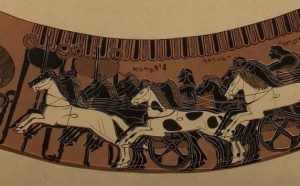
A. Furtwaengler and K. Reichhold, Griechische Vasenmalerei: Auswahl hervorragender Vasenbilder (Serie III, 1932), pl. 121: detail of racers Euphemos and Kastor

A. Furtwaengler and K. Reichhold, Griechische Vasenmalerei: Auswahl hervorragender Vasenbilder (Serie III, 1932), pl. 121: detail of racers Kastor, Admetos, Alastor, Amphiaraos and Hippasos
Perseus Art & Archaeology Artifact Browser
Beazley Archive Pottery Database
♠ Fab 14.4 – Hyginus, Fabulae
Hippalcimus, son of Pelops and Hippodamia, daughter of Oinomaus, from the Peloponnesus. Latin Text
Previous Page Table of Contents Next Page
Tags:
#Admetos, #Akastos, #Amphiaraos, #Hippalkimos, #Kastor, #Mopsos, #Peleus, #Pelias
Artistic sources edited by R. Ross Holloway, Elisha Benjamin Andrews Professor Emeritus, Joukowsky Institute for Archaeology and the Ancient World, Brown Univ., and Frances Van Keuren, Prof. Emerita, Lamar Dodd School of Art, Univ. of Georgia, January 2020.
Literary sources edited by Elena Bianchelli, Retired Senior Lecturer of Classical Languages and Culture, Univ. of Georgia, February 2022
