Chapter 2: The Olympians
Previous Page Table of Contents Next Page
♠ Il 14.326 – Homer, Iliad
nor of Demeter, the fair-tressed queen. Greek Text
♠ Od 5.125-28 – Homer, Odyssey
Thus too, when fair-tressed Demeter, yielding to her passion, lay in love with Iasion in the thrice-ploughed fallow land, Zeus was not long without knowledge thereof, but smote him with his bright thunder-bolt and slew him. Greek Text
♠ Th 912-14 – Hesiod, Theogony
Also he came to the bed of all-nourishing Demeter, and she bore white-armed Persephone whom Aidoneus carried off from her mother; but wise Zeus gave her to him. Greek Text
♠ Th 969-74 – Hesiod, Theogony
Demeter, bright goddess, was joined in sweet love with the hero Iasion in a thrice-ploughed fallow in the rich land of Crete, and bore Plutus, a kindly god who goes everywhere over land and the sea’s wide back, and he makes rich the man who finds him and into whose hands he comes, bestowing great wealth upon him. Greek Text
♠ Hes fr 185 MW – Hesiod, Ehoiai (Catalogue of Women) in Fragmenta Hesiodea, pp. 88-89, ed. R. Merkelbach and M. L. West. Oxford 1967.
♠ Hes fr 177.8-12 MW – Hesiod, Ehoiai (Catalogue of Women) in Fragmenta Hesiodea, p. 85, ed. R. Merkelbach and M. L. West. Oxford 1967.
and Eetion
who went to bountiful Demeter’s bed.
[10] And the father of men and gods killed
lord Eetion striking him with a shining thunderbolt,
because he lay with Demeter in love and marriage. (Transl. E. Bianchelli)
♠ Hellanikos 4F23 FGrH – Die Fragmente der griechischen Historiker 1, p. 113, ed. F. Jacoby, 2d ed. Leiden 1957.
See below Greek Text
♠ Hellanikos 4F135 FGrH – Die Fragmente der griechischen Historiker 1, p. 139, ed. F. Jacoby, 2d ed. Leiden 1957.
♠ Hellanikos 4F23 FGrH – Die Fragmente der griechischen Historiker 1, p. 113, ed. F. Jacoby, 2d ed. Leiden 1957.
……….
and he [Hellanikos] says that this Iasion/Eetion was stuck by a thunderbolt because he maltreated an “agalma” (statue? honor?) of Demeter. (Transl. T. N. Gantz)
……
♠ Od 11.217 – Homer, Odyssey
in no way does Persephone, the daughter of Zeus, deceive thee. Greek Text
♠ Theognis 704 – Iambi et Elegi Graeci 1, p. 208, ed. M.L. West. Oxford 1971.
Aeolus’ son Sisyphus, whose wheedling words persuaded Persephone.
♠ Cho 490 – Aischylos, Choephoroi (Libation Bearers)
Electra
O Persephone, grant us indeed a glorious victory! Greek Text
♦ Dresden, Albertinum 350: Attic red-figure calyx krater with Persephone, Hermes and Silenoi
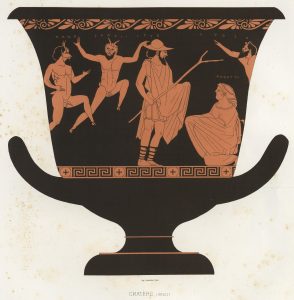
N. Des Vergers, L’Étrurie et les Étrusques: ou, Dix ans de fouilles dans les Maremmes toscanes, vol. 3 (1862-64), pl. 10
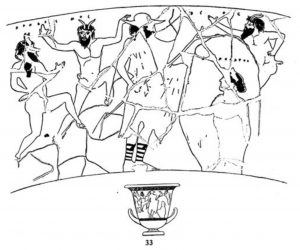
P. Herrmann, “Erwerbungen der Antikensammlungen in Deutschland,” Archäologischer Anzeiger 1892, 166 fig. 33
Beazley Archive Pottery Database
♠ Plato, Kratilos 404c
and Hera is a lovely one (ἐρατή), as indeed, Zeus is said to have married her for love. But perhaps the lawgiver had natural phenomena in mind, and called her Hera (Ἥρα) as a disguise for ἀήρ (air), putting the beginning at the end. You would understand, if you were to repeat the name Hera over and over. And Pherephatta!—How many people fear this name, and also Apollo! I imagine it is because they do not know about correctness of names. You see they change the name to Phersephone and its aspect frightens them. But really the name indicates that the goddess is wise. Greek Text
♠ HDem 439 – Homeric Hymn 2 to Demeter
Hecate came near to them, and often did she embrace the daughter of holy Demeter. Greek Text
♠ Lasos 702 PMG – Poetae Melici Graeci, pp. 364-65, ed. D. L. Page. Oxford 1962.
♦ Eleusis, Archaeological Museum 596: Attic red-figure vase fragment with Persephone (Kore)
Beazley Archive Pottery Database
J.D. Beazley, “Some Inscriptions on Vases—II,” American Journal of Archaeology 33 (1929), 363-4.
♠ HF 609 – Euripides, Herakles Mainomenos (Heracles Furens)
After my return at length from the sunless den of Hades and the maiden queen of hell, I will not neglect to greet first of all the gods beneath my roof. Greek Text
♠ ApB 1.3.1 – Apollodoros, Bibliotheke (Library)
by Styx he [Zeus] had Persephone. Greek Text
♠ Th 912-14 – Hesiod, Theogony
Also he came to the bed of all-nourishing Demeter, and she bore white-armed Persephone whom Aidoneus carried off from her mother; but wise Zeus gave her to him. Greek Text
Previous Page Table of Contents Next Page
Tags:
#Hermes, #Persephone, #Silenoi
Artistic sources edited by R. Ross Holloway, Elisha Benjamin Andrews Professor Emeritus, Joukowsky Institute for Archaeology and the Ancient World, Brown Univ., and Frances Van Keuren, Prof. Emerita, Lamar Dodd School of Art, Univ. of Georgia, April 2018.
Literary sources edited by Elena Bianchelli, Senior Lecturer of Classical Languages and Culture, Univ. of Georgia, August 2020
